
Summary
YBK provides a self-hosted governance control plane for tracking and managing enterprise AI assets.
About
YBK addresses governance of organizational AI infrastructure by consolidating asset inventory, permissions, lifecycle tracking, cost attribution, and audit information in one control plane.
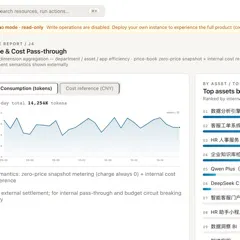
YBK treats MCP servers, skills, agents, and AI applications as governed assets. It records five asset types in a shared ledger with lifecycle states, a common identity and permission model, cost attribution by department, agent, and skill, and an audit trail. Dependency topology and blast-radius analysis support assessment of relationships and potential impact. The software is described as fully self-hosted and MIT-licensed, and uses Node 22 with node:sqlite and no added dependencies.
Key Features
Shared ledger covering five AI asset types, including MCP servers, skills, agents, and applications
Lifecycle state machine for tracking asset status
Common identity and permission model with an audit trail
Cost attribution across departments, agents, and skills
Dependency topology and blast-radius analysis
Real-World Use Cases
AI asset inventory and lifecycle governance
Maintain a centralized record of AI-related infrastructure and track assets through defined lifecycle states.
Department-level AI cost attribution
Attribute costs across departments, agents, and skills to support internal reporting and resource allocation.
Dependency and impact assessment
Review relationships among AI assets and assess potential blast radius when evaluating changes or incidents.
Access control and audit readiness
Apply a shared permission model and retain an audit trail for governed AI assets.
Business Opportunities
Enterprise AI governance deployment
Problem: Organizations may operate multiple AI assets without a unified inventory, permission model, or audit trail.
Solution: Deploy YBK as a self-hosted control plane to register assets and manage lifecycle, access, and audit information centrally.
Estimated ROI: Potentially meaningful where fragmented asset oversight creates governance and operational overhead; actual returns depend on deployment scope and existing processes.
Execution: Identify AI assets across teams, configure lifecycle and permission practices, then onboard assets into the shared ledger.
AI infrastructure cost allocation
Problem: AI-related costs can be difficult to assign to the departments and components responsible for them.
Solution: Use attribution by department, agent, and skill to support internal cost reporting and allocation.
Estimated ROI: Potential savings or improved budget accountability through clearer cost ownership; the description provides no quantified outcomes.
Execution: Map assets to departments and agents, establish attribution practices, and use the resulting ledger for internal cost reviews.
AI dependency risk assessment
Problem: Changes to one AI component may affect dependent assets, while relationships can be difficult to assess across teams.
Solution: Use dependency topology and blast-radius analysis to inform change planning and impact reviews.
Estimated ROI: Potentially reduced disruption and investigation effort when dependency information is complete and kept current.
Execution: Register asset dependencies and incorporate topology reviews into change management and incident assessment workflows.