
Anthropic Adds Six Drug-Development Partners and Acquires Mithril Medicine
AI Healthcare

Anthropic Adds Six Drug-Development Partners and Acquires Mithril Medicine

AnthropicOct 29, 2026

Anthropic detailed six life-sciences partnerships and acquired Mithril Medicine as it begins internal drug-discovery programs using Claude.

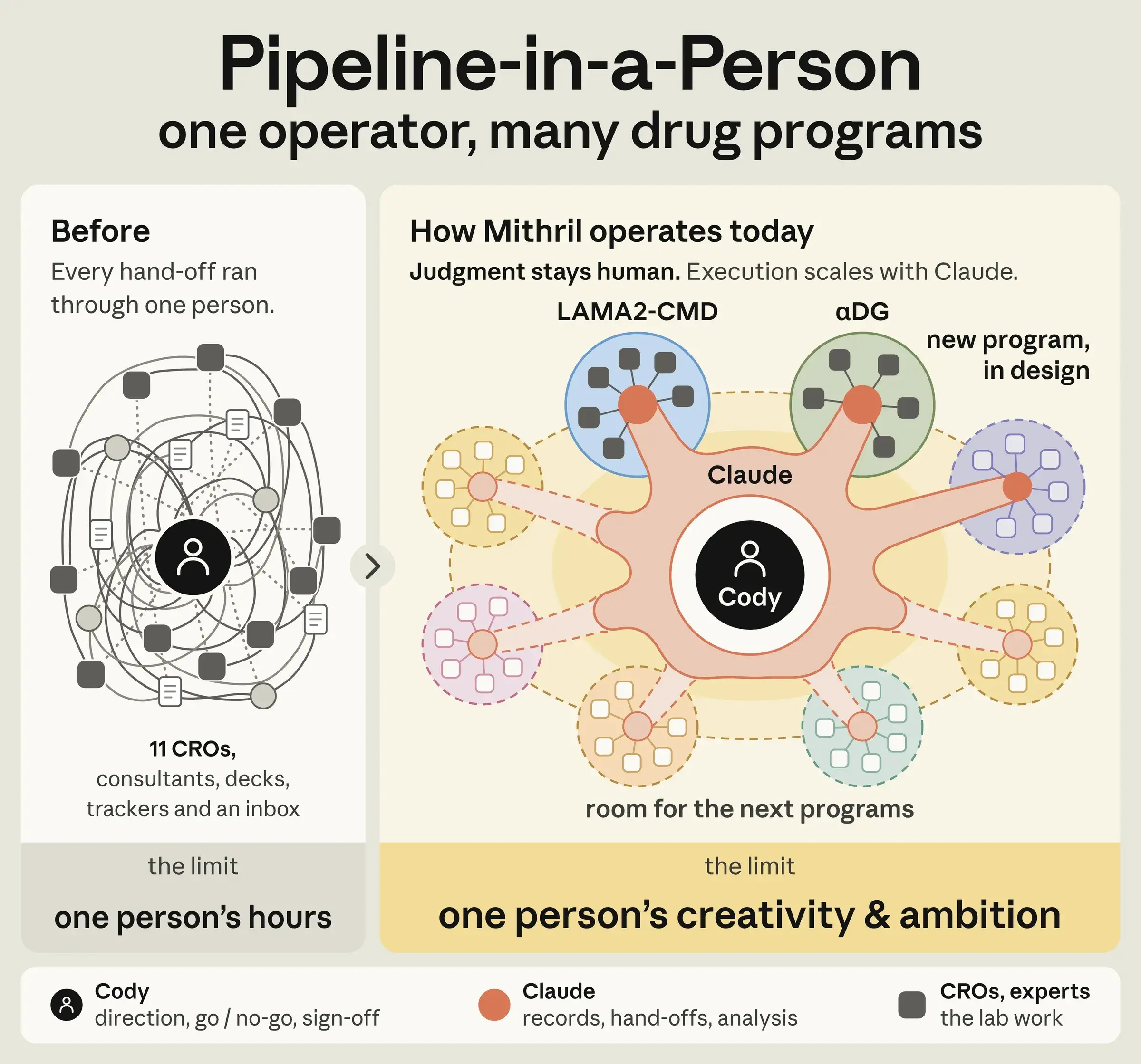
Anthropic says it is expanding its work in drug development through research partnerships with six organizations and the acquisition of Mithril Medicine, a one-person company pursuing treatments for two rare forms of muscular dystrophy. The October 27 announcement marks a move beyond supplying AI tools to outside researchers: Anthropic says it has started its own drug-discovery programs, with Mithril founder Cody Tranbarger continuing the work after joining the company.

The company described projects spanning different stages of development. At Generate Biomedicines, researchers used Claude Code to propose a shortened genetic instruction for a potential CAR T-cell therapy. In laboratory tests, the design helped immune cells produce more receptors and kill tumor cells more efficiently. At Divergence Labs, Claude generated roughly 35,000 antibody designs for a proposed food-allergy treatment; early tests identified candidate designs for further work. Anthropic also reported that Enveda used Claude to review manufacturing documentation and draft regulatory materials, while Bristol Myers Squibb is testing the model for clinical-trial planning.

Anthropic said Mithril used Claude to coordinate contracts, logistics and experiments with 11 external laboratories. The company reports that one possible treatment advanced from an idea to promising results in mice in less than 18 months. Anthropic says a drug candidate could be ready to begin human clinical trials as soon as late 2028 if the research continues to hold up. These are company-reported, early-stage findings—not evidence of an approved or proven treatment.

The broader strategy is to involve Claude across the drug-development process, from identifying targets and designing molecules to manufacturing, regulatory filings and clinical trials. Anthropic argues that bottlenecks occur throughout this chain, so working directly with drug programs can reveal where models help and where they need improvement. It says the partnerships have already informed plans to improve Claude, and that it intends to scale the work.

Most of the research remains preclinical, and Anthropic acknowledges that substantial testing and development lie ahead. The company says it also aims to share its models with researchers through Claude Science, credits for life scientists and a verification program for trusted organizations. The announcement signals a deeper life-sciences push, while leaving the therapeutic impact dependent on future validation.

Industry Impact

Anthropic moves into drug discovery

Biotechnology, pharmaceuticals, life sciences

Overview

Anthropic is extending Claude’s role from supporting external researchers to powering drug programs it runs itself, using Mithril Medicine’s rare-disease research as an initial case. The partnerships span molecule design, manufacturing documentation and clinical-trial planning, giving life-sciences researchers and healthcare leaders examples of potential applications across development stages. Near term, results remain preclinical and require validation. Longer term, the work could help Anthropic refine its models for scientific workflows while giving drug developers evidence to assess where AI can contribute—and where human and laboratory validation remain essential.

Key Impact Points

Anthropic is combining external partnerships with internally run drug-discovery programs, deepening its commitment to life sciences.

Reported examples cover design, manufacturing and trial planning, suggesting potential applications across multiple drug-development workflows.

Mithril’s mouse results and possible late-2028 trial timeline are early company-reported milestones, not proof of treatment efficacy.

Opportunities

AI-assisted drug-development workflows

Biotechnology, pharmaceuticals, life sciences

The partnerships point to opportunities for research organizations to evaluate AI assistance across drug-development workflows, from designing candidate molecules to preparing manufacturing and regulatory documentation. Claude’s use at Mithril to coordinate work with external laboratories also illustrates a potential role in organizing complex research operations. Anthropic says it plans to make models available to researchers through Claude Science, credits for life scientists and a verification program for trusted organizations. These are access initiatives, not evidence of a validated commercial offering or proven drug-development gains. Organizations considering adoption should treat model outputs as candidates for expert review and laboratory testing.

  • AI-supported drug-development research

    Problem: Drug-development work spans molecule design, laboratory coordination, manufacturing documentation and clinical planning.

    Solution: Evaluate Claude for bounded research and operational tasks, with expert review and experimental validation.

    Target Users: Life-sciences researchers, biotechnology companies and pharmaceutical teams.

    Business Value: Could support work across development stages; the article reports early examples but does not establish consistent productivity gains.

    Revenue Potential: Not specified. Anthropic describes researcher access through Claude Science, credits and a verification program, but gives no pricing or commercial revenue details.

Reference link

https://anthropic.com/research/early-progress-drug-development

Image Source Link

https://www.rdworldonline.com/wp-content/uploads/2026/10/548184bda60fac7efdc36c089b1d5144ef0642da-2400x2239-1.webp

Community Discussion (0)

No discussions yet. Be the first to start the conversation!