
AWS and Okta Demonstrate Controls for AI Agents Acting for Users
AI Agents & Automation

AWS and Okta Demonstrate Controls for AI Agents Acting for Users

AWS Machine LearningNov 8, 2026

AWS’s technical guide combines Okta Cross App Access with Bedrock AgentCore to govern agent permissions and report observed authorization and latency tests.

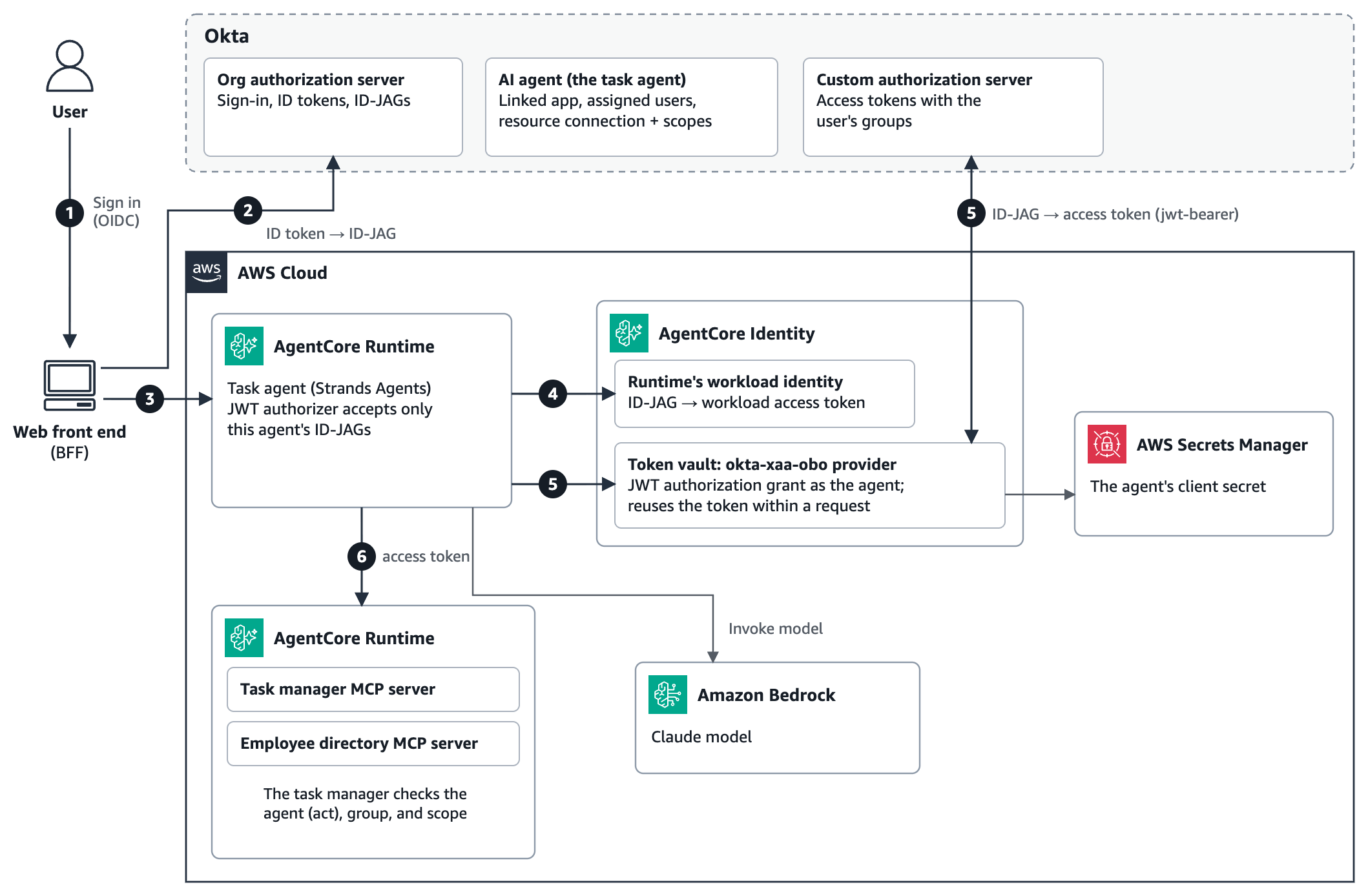
AWS published the first part of a technical guide on November 6, 2026, showing how to pair Okta Cross App Access with Amazon Bedrock AgentCore to control AI agents acting for signed-in users. The approach assigns Okta responsibility for deciding which agent may access which applications for a user, while AgentCore validates that decision and obtains the access token needed by the agent.

In the described flow, an administrator registers an agent and approves its application connections in Okta. Each request carries a short-lived authorization grant; AgentCore Runtime checks that the grant was issued for the correct agent, and AgentCore Identity exchanges it for a resource access token without exposing the agent’s credentials to its code. The target application then checks both the agent’s identity and the user’s permissions before allowing an action.

AWS reports that, in its tests, removing a user’s assignment to an agent blocked new requests in about one second, while already-issued tokens remained valid for up to five minutes. AgentCore Identity added about 0.6 seconds to a request that took roughly 30 seconds end to end. In a three-user example, a user in the writers group could create tasks; users without that authority could read them but were denied permission to create them. The guide also describes failures found during testing, including cases where missing group checks or an insufficient agent-identity check allowed unauthorized actions.

The post is a hands-on, first installment, not a claim that the sample is ready for production: AWS says its code is for non-production use and requires organizations to assess their own security and compliance needs. A second installment is planned to cover a design using AgentCore Gateway, Cedar policies, an agent on Amazon EKS, and audit events in CloudWatch. The approach is intended to make user authority and agent identity explicit at each step.

Industry Impact

Making agent permissions explicit

Enterprise AI, identity and access management, cloud application security

Overview

AWS and Okta’s guide shows how organizations can check both an agent’s identity and a user’s permissions before an agent acts in connected applications. For developers and security teams, it offers a concrete authorization pattern and test results: removing a user’s agent assignment blocked new requests in about one second, while issued tokens could remain valid for up to five minutes. The sample is explicitly non-production, so compliance and security teams still need to assess their own controls before adoption.

Key Impact Points

Okta handles agent-to-application authorization; AgentCore validates grants and obtains resource access tokens without exposing agent credentials to its code.

The reported tests highlight a revocation gap: new requests were blocked quickly, but already-issued tokens could remain valid for up to five minutes.

AWS found that missing group checks or insufficient agent-identity checks could permit unauthorized actions, underscoring the need for layered authorization.

Opportunities

Build safer agent integrations

Enterprise AI, identity and access management, cloud application security

The guide points to a practical opportunity for organizations building agent workflows: integrate identity-provider decisions with runtime validation and application-level permission checks. Developers and security teams can use the pattern to evaluate whether agents act only within a user’s authority, while testing revocation behavior and token lifetimes. Implementation services or internal platform components could help teams adapt these controls across applications, but the article provides no evidence of customer demand or commercial results. AWS labels the sample non-production, so any deployment requires independent security and compliance assessment. A second installment is planned to cover a design involving AgentCore Gateway, Cedar policies, an EKS-hosted agent, and CloudWatch audit events.

  • Agent authorization integration and assessment

    Problem: Organizations need to ensure agents acting for users have the right application access and cannot exceed user permissions.

    Solution: Adapt and test an authorization flow that checks agent identity, user permissions, grants, and resource access tokens across the agent runtime and target applications.

    Target Users: Enterprise software developers, cybersecurity teams, and organizations deploying AI agents with access to connected applications.

    Business Value: Helps teams identify gaps such as missing group checks and evaluate revocation and token-lifetime behavior before production decisions.

    Revenue Potential: Unquantified. The article supports a technical integration and assessment opportunity but provides no pricing, demand, or commercial results.

Reference link

https://aws.amazon.com/blogs/machine-learning/govern-ai-agent-access-with-okta-cross-app-access-and-amazon-bedrock-agentcore-part-1

Image Source Link

https://d2908q01vomqb2.cloudfront.net/f1f836cb4ea6efb2a0b1b99f41ad8b103eff4b59/2026/10/29/ML-21547-1.png

Community Discussion (0)

Loading discussions...