
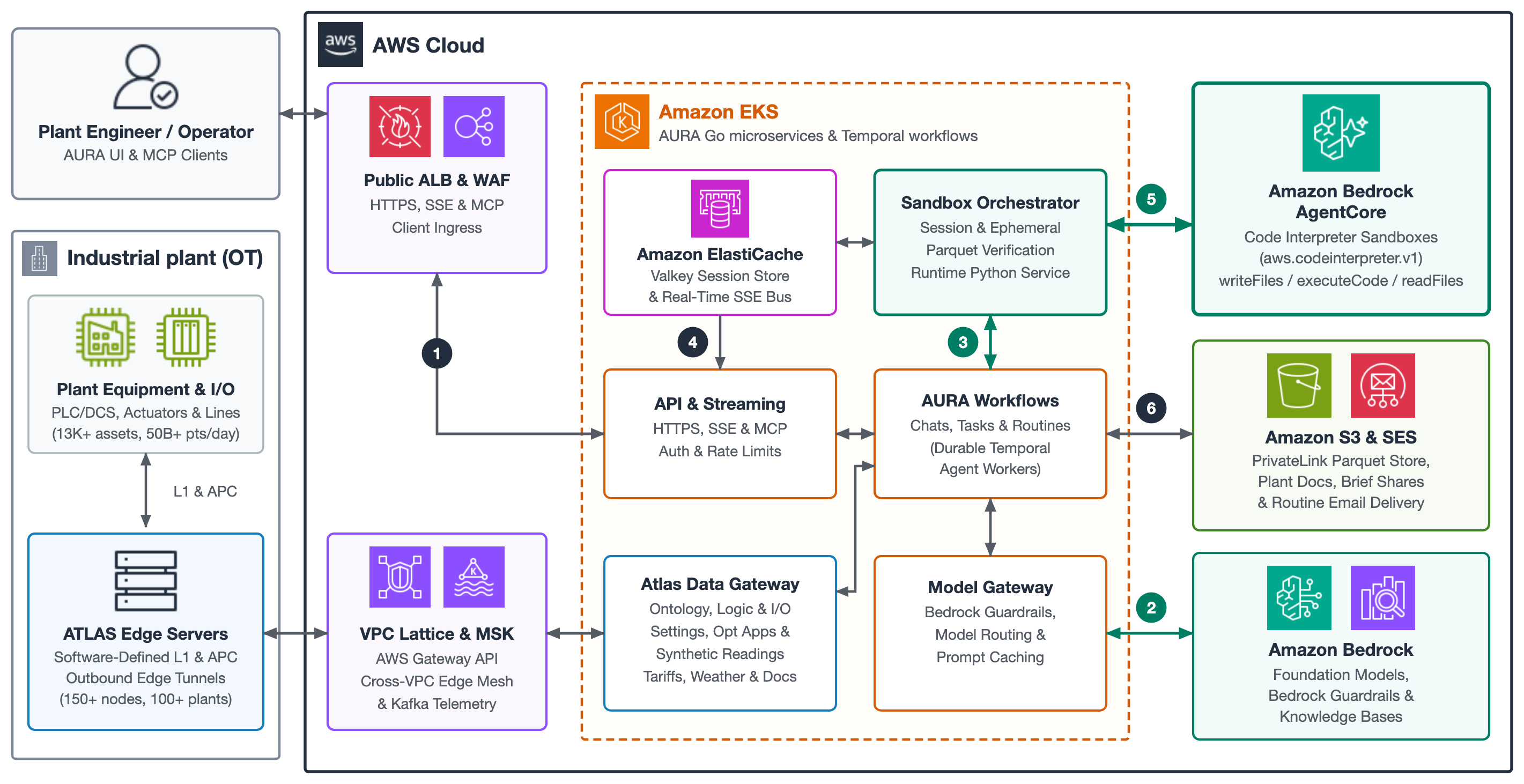
CrossnoKaye says its AURA system uses isolated Python execution and live plant data to produce evidence-backed analyses while keeping equipment controls bounded.
CrossnoKaye is using Amazon Bedrock AgentCore as part of AURA, its AI system for industrial operations, according to an AWS post published November 9, 2026. AURA works with ATLAS, CrossnoKaye’s software-defined automation platform, which connects plant data and AI reasoning with equipment controls at food and beverage facilities, industrial refrigeration sites, quarries, and manufacturing plants.
CrossnoKaye says its platform spans more than 100 facilities and 13,000 controlled assets, stores over 22 trillion machine data points, and ingests more than 50 billion readings each day. It also runs more than 1,000 advanced process control applications. The company reports those applications improve throughput by 11–17 percent and reduce total facility energy costs by an average of 21 percent; these are company-reported results, not an independent evaluation of AURA.
For numerical analysis, AURA can send Python workloads to isolated, AWS-managed microVM sandboxes through AgentCore’s code interpreter. The system checks input and output data contracts and can retry calculations when scripts fail validation. AURA supports interactive engineering chats, repeatable investigations, and automated routines that monitor for specified process conditions. In one example described by AWS, an overnight routine investigates a refrigeration pressure drift and sends engineers a cited report within four minutes; the example says the system does not make control changes automatically.
The safety design keeps AI analysis separate from direct equipment control. Automated routines run read-only, and proposed setting changes require explicit approval from an engineer. ATLAS’s local control narratives and equipment interlocks continue to enforce operating limits at the plant edge. CrossnoKaye also reports that investigations which previously took hours can now produce cited technical briefs in under four minutes. The company says its broader deployments have reduced batch-drying-time variation by 34 percent and identified over 50,000 tons per year of recoverable production gap in quarry operations.