
Duco rebuilds AWS-based agents and reports tenfold faster reconciliation deployments
AI Finance & Banking

Duco rebuilds AWS-based agents and reports tenfold faster reconciliation deployments

AWS Machine LearningNov 17, 2026

AWS says Duco’s Bedrock-based agents cut reconciliation deployment time tenfold, reduced one bank’s onboarding costs 70%, and trimmed context use.

Duco has rebuilt its agent platform for financial operations using Amazon Bedrock and Amazon Bedrock AgentCore, AWS reported on November 16, 2026. The company serves more than 200 financial institutions and, according to AWS, processes 20 billion transactions each month. Its platform handles reconciliation and other data-intensive workflows for banks and asset managers.

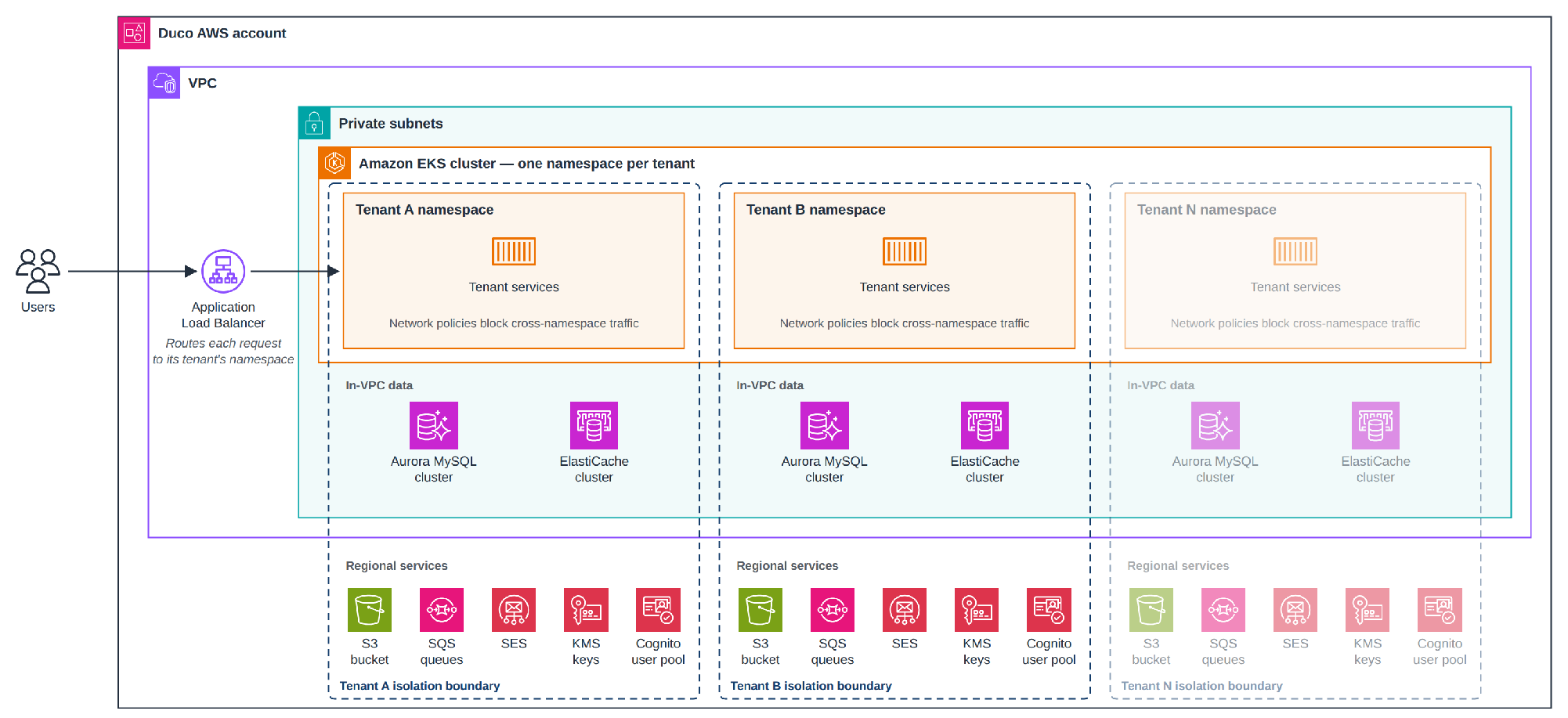
The AWS case study describes an architecture designed to keep each institution’s data and agent context separate. Duco provisions a dedicated AgentCore runtime and gateway per tenant, alongside isolated data services and tenant-specific access controls. The setup preserves much of the company’s existing LangChain and LangGraph code. Duco also uses several models for different tasks, including planning, exception investigation, tool routing and summarizing tool results.

A separate design change addresses the amount of information agents receive before working. AWS says Duco had exposed agents to 300–400 tools per tenant, with descriptions taking roughly 200,000 tokens. By loading skill and tool details on demand through an MCP-based architecture, Duco reduced the main context to about 20,000 tokens. AWS reports that the change also improved response quality in Duco’s evaluations while retaining the same underlying models, tools and tasks.

The agents support onboarding and exception investigation. They can help interpret legacy file formats and configurations, including complex spreadsheet macros, and prepare new reconciliation processes. For exceptions, they gather evidence, identify likely causes and propose possible resolutions; analysts review the resulting cases and make final decisions. AWS says high-risk actions require explicit authorization and that decisions are logged for audit.

AWS attributes several reported business results to Duco’s deployments: reconciliation processes are deployed 10 times faster, one global bank reduced onboarding costs by 70%, and straight-through processing at that bank rose by more than 20%. The case study also reports thousands of hours saved in manual investigation. These are company-specific outcomes described by AWS, not a general benchmark for financial institutions.

Industry Impact

Faster financial operations

Banking, asset management and financial services

Overview

Duco’s deployment shows how financial institutions can apply agents to reconciliation onboarding and exception investigation without handing final decisions to software. For banking leaders, the reported 10× deployment speed, 70% lower onboarding costs at one global bank and more than 20% higher straight-through processing suggest operational upside, but these are company-specific results reported by AWS, not sector benchmarks. Technology teams should note tenant-isolated runtimes, on-demand tool loading and human approval for high-risk actions; these design choices address data separation, context load and auditability as firms assess production use.

Key Impact Points

Duco reports reconciliation processes deployed 10 times faster, potentially shortening implementation cycles for financial institutions.

At one global bank, AWS reports onboarding costs fell 70% and straight-through processing rose by more than 20%.

Tenant isolation, logged decisions and analyst review of cases offer a model for balancing automation with control.

Opportunities

Automating reconciliation workflows

Banking, asset management and financial services

Financial institutions with labor-intensive reconciliation onboarding or exception investigation can assess whether agents can reduce manual work and deployment effort. Duco’s example points to practical capabilities: interpreting legacy file formats, preparing reconciliation processes, gathering evidence and proposing exception resolutions for analyst review. Its on-demand tool loading also suggests a way to reduce agent context while maintaining access to tenant-specific tools. Any adoption should be evaluated against institution-specific data separation, authorization, audit and accuracy requirements. The case study provides evidence of potential value at Duco and one bank, but not a general benchmark or a guaranteed savings level for other organizations.

  • Agent-assisted reconciliation onboarding and exception handling

    Problem: Reconciliation setup can involve complex legacy file formats and configurations, while exception investigation requires manual evidence gathering.

    Solution: Use agents to help interpret inputs, prepare reconciliation processes, gather evidence and propose resolutions for analyst review.

    Target Users: Banks and asset managers managing data-intensive reconciliation workflows.

    Business Value: Potentially faster deployment and less manual investigation; AWS reports specific results for Duco deployments, including outcomes at one global bank.

    Revenue Potential: Could support enterprise software or implementation services for financial institutions, but the article provides no market-size or pricing evidence.

Reference link

https://aws.amazon.com/blogs/machine-learning/how-duco-transforms-financial-data-automation-with-amazon-bedrock-agentcore

Image Source Link

https://d2908q01vomqb2.cloudfront.net/f1f836cb4ea6efb2a0b1b99f41ad8b103eff4b59/2026/11/02/ML-20525-1.png

Community Discussion (0)

Loading discussions...