
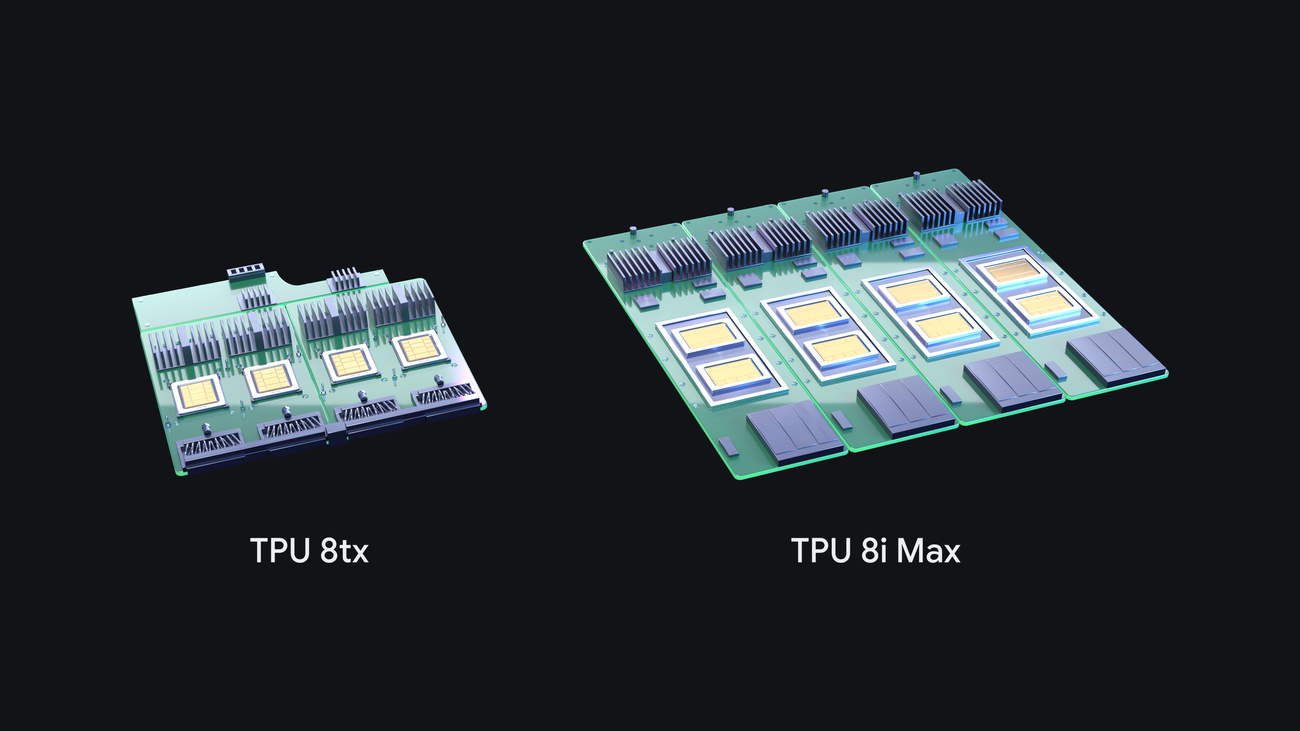
Google expanded its eighth-generation TPU lineup with two systems aimed at confidential inference and workloads that require large context windows.
Google announced two additions to its eighth-generation Tensor Processing Unit portfolio on November 9: TPU 8tx, designed for secure and confidential inference, and TPU 8i Max, aimed at workloads with very large context windows. The company’s announcement makes the systems part of a four-system generation alongside TPU 8t and TPU 8i.
Google describes 8tx as a system with hardware-level security features for sensitive workloads. The 8i Max is designed for high context capacity and compute density per rack. These are system configurations, not simply newly announced processor chips: Google says it combines compute with networking, storage, packaging and security features to tailor infrastructure to different AI workloads.
The launch reflects a growing infrastructure need as AI systems handle longer prompts and more multi-step agent activity. Long-context tasks can place substantial demands on memory and communication between accelerators, while regulated customers may require protections for data used during inference. Google is pitching the two configurations at those different constraints rather than presenting one general-purpose replacement for its existing systems.
The announcement also expands Google’s eighth-generation portfolio to cover different stages of AI work. The company characterizes TPU 8t as a training-focused system and TPU 8i as a reasoning-focused system; the new 8tx and 8i Max extend that lineup toward confidential inference and larger context workloads. Google says the systems are intended to fit into its AI Hypercomputer infrastructure and software stack, and points to work to make TPUs more accessible to developers and cloud customers.
Google did not frame this announcement as a new chip fabrication process or disclose a standalone price for either system in the post. Instead, it emphasized modular system design and specialized configurations. Availability, customer uptake and independent comparisons of performance will determine how much the additions change the options for organizations training or serving large models. The announcement came as Google said its TPU business served nearly 100 customers, including research organizations and commercial firms.