
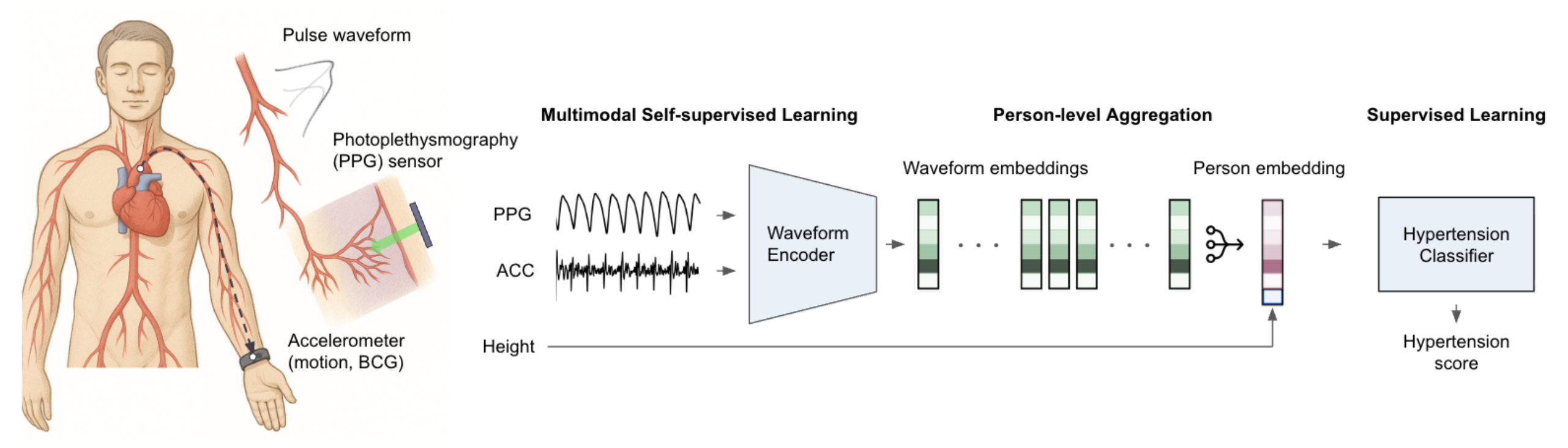
Google researchers say an AI system using smartwatch pulse and motion sensors detected hypertension in a clinical study without cuff calibration.
Google Research has reported an AI system that uses signals from standard smartwatch sensors to identify signs of persistent high blood pressure, without requiring calibration against an arm cuff. The findings, published in Nature and described by Google on November 5, could point toward a way to flag people who might otherwise miss hypertension screening. The system does not estimate a user’s exact blood pressure at a particular moment; instead, it combines patterns collected over multiple days to classify hypertension risk.
The model analyzes photoplethysmography, which measures changes in blood volume using reflected light, alongside accelerometer data that captures subtle wrist motion associated with the heartbeat. Google says it pretrained the system on 492,347 hours of sensor data from 2,109 consenting participants. In a separate prospective study across five U.S. sites, researchers evaluated it in 196 participants against 24-hour ambulatory blood-pressure monitoring, a clinical reference standard.
For initial screening, the system recorded 65.8% sensitivity and 90.0% specificity. In a smaller confirmatory-testing group of 48 participants who had initially elevated office readings, it reached 78.4% sensitivity and 90.9% specificity. Those results suggest potential as a passive screening aid, but they do not establish that smartwatch-based AI can replace clinical measurements or diagnose hypertension on its own.
Google says the research informed the blood-pressure-trend feature in its Google Health app, but emphasizes that the study’s system is exploratory and does not represent an existing or planned device capability. The distinction matters: the study evaluates a research method, not a newly announced diagnostic product. If further validated in larger and more varied populations, passive screening could help prompt people to seek formal assessment; for now, people should rely on standard clinical guidance and blood-pressure measurements for diagnosis and treatment decisions.