
NVIDIA Demonstrates AI Agents Building Simulations for Robotics and Autonomous Vehicles
AI Agents & Automation

NVIDIA Demonstrates AI Agents Building Simulations for Robotics and Autonomous Vehicles

NVIDIAOct 8, 2026

NVIDIA presented examples of agents using Omniverse tools to create simulations for warehouse robots, autonomous driving, sensor validation and other tasks.

On October 8, 2026, NVIDIA detailed a collection of developer projects in which AI agents helped assemble simulation applications using NVIDIA Omniverse libraries. The examples show agents responding to natural-language direction while developers review outputs and steer revisions; the libraries supply GPU-accelerated physics, rendering and sensor simulation.

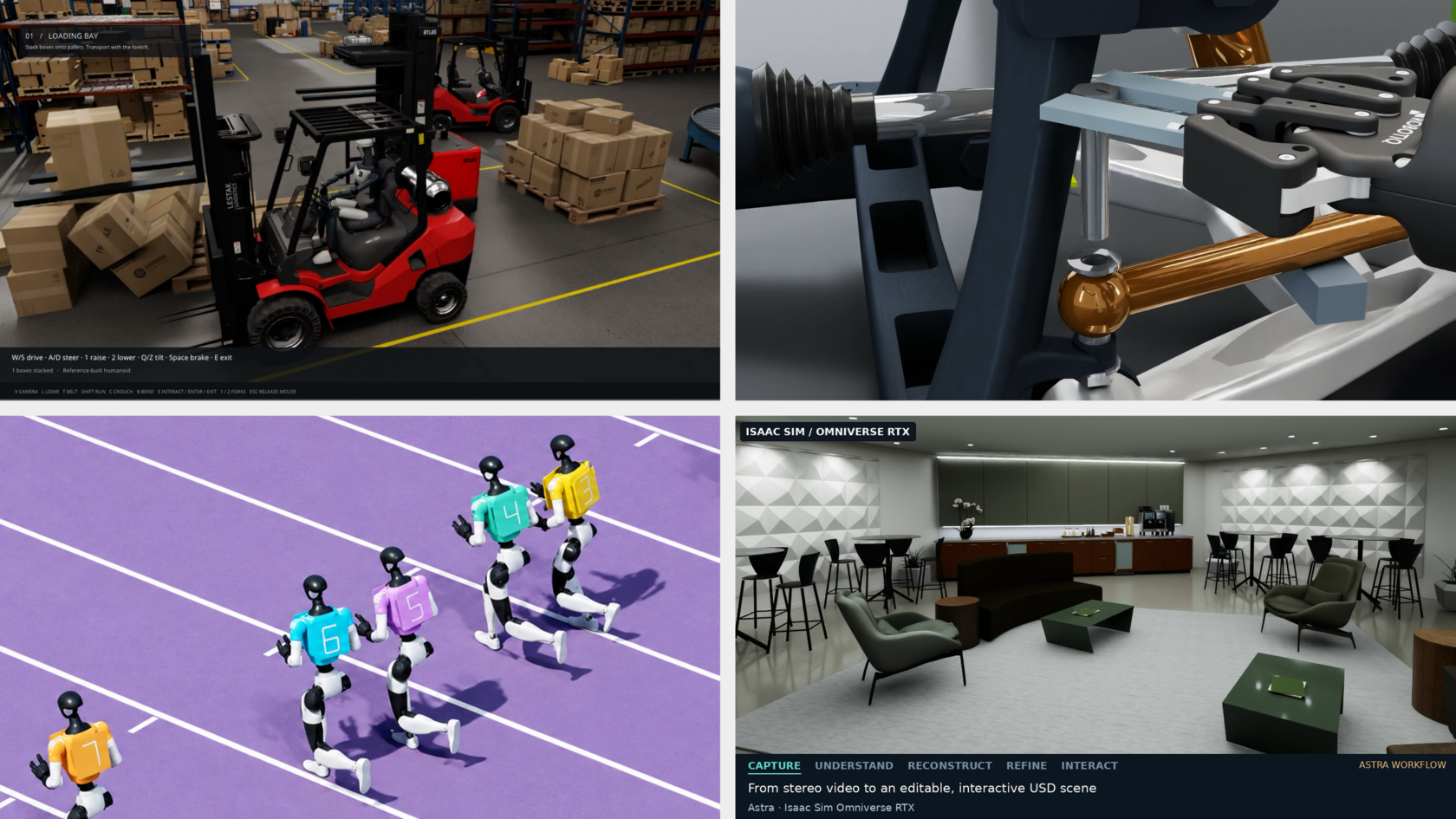
The demonstrations cover several stages of robotics and autonomous-vehicle development. In one, NVIDIA’s Frank DeLise used GPT-6 Astra to connect warehouse assets, robot models, physics and interface components into an interactive humanoid simulator. Another project used Astra to build a reusable San Francisco Market Street environment for autonomous-driving tests, linking traffic, assets and RTX sensor simulation so developers could compare driving models and examine how scene changes affect results.

NVIDIA also described an effort to compare simulated camera and raw LiDAR outputs against recorded data. Over roughly three days, Ashley Reid guided Astra and Claude Fable 5 agents through creating two digital twins and improving two existing ones. The workflow used measured differences to identify issues such as missing objects, geometry and materials.

Other examples applied simulation to robot skills and product disassembly. In an experimental sports project, a simulated Unitree G1 cleared a single hurdle in 64 of 100 trials. For a car-suspension disassembly task, an agent helped model the part and design a wrench that could reach its bolts; NVIDIA reported successful simulated removal of a suspension component.

The projects are demonstrations of agent-assisted workflows, not evidence that agents can independently validate real-world systems. Across the examples, developers remained involved in directing work and assessing results. NVIDIA also showed agents assembling a browser-based International Space Station model with telemetry and converting captured room geometry into an editable environment for interaction testing.

Industry Impact

Faster Simulation Development

Robotics, warehousing, and automotive

Overview

NVIDIA’s demonstrations suggest AI agents can help developers assemble and revise simulation environments for warehouse robots and autonomous-driving tests. Teams may use these workflows to reduce manual setup and compare simulated sensor data with recorded data, while developers remain responsible for directing work and judging results. In the short term, the examples offer practical patterns for simulation and robotics teams to evaluate. Longer term, agent-assisted authoring could make scenario iteration more accessible, but the demonstrations do not establish that agents can independently validate real-world systems.

Key Impact Points

Agents helped connect simulation assets, robot models, physics, and interfaces from natural-language direction.

Reusable driving environments and sensor comparisons could support repeatable testing and identification of scene mismatches.

Human review remains essential; the reported successes are simulated results, not evidence of real-world validation.

Opportunities

Agent-Assisted Simulation Workflows

Robotics, logistics, and automotive development

Simulation teams could explore agent-assisted workflows to assemble environments, connect assets and physics, and revise digital twins using natural-language direction. The article’s sensor-comparison example also points to a practical testing workflow: compare simulated camera and LiDAR outputs with recorded data, then investigate missing objects, geometry, or materials. These capabilities may help developers iterate on scenarios and simulation content, but the examples do not establish production readiness or independent validation. Organizations should treat them as developer-led prototypes, measure time saved and defect discovery on representative projects, and confirm that simulated results meet their own validation standards before relying on them.

  • Developer-Led Simulation Authoring and Validation

    Problem: Building and updating detailed simulation environments and checking them against recorded sensor data can require substantial developer effort.

    Solution: Evaluate AI agents as assistants for assembling simulation components, revising digital twins, and identifying differences between simulated and recorded outputs, with developers reviewing the results.

    Target Users: Robotics, warehouse automation, and autonomous-driving development teams.

    Business Value: Potentially reduce manual setup and support faster iteration; the article provides demonstrations, not measured productivity gains.

    Revenue Potential: No revenue model or commercial results are reported. Any opportunity would depend on adoption of agent-assisted simulation workflows and demonstrated value to development teams.

Reference link

https://blogs.nvidia.com/blog/developers-simulation-frontier-ai-agents

Image Source Link

https://blogs.nvidia.com/wp-content/uploads/2026/10/Copy-of-nvidia-ov-x-astra-4up-KV-r1-press-4k-r2-1680x945.png

Community Discussion (0)

No discussions yet. Be the first to start the conversation!