
NVIDIA Expands GPU Software to Speed Scientific Analysis
AI Research & Science

NVIDIA Expands GPU Software to Speed Scientific Analysis

NVIDIANov 17, 2026

NVIDIA outlined CUDA-X tools and partner workflows that accelerate astronomy, fusion simulation, molecular modeling, materials research and biological data analysis.

NVIDIA described new and expanded CUDA-X software for scientific computing on November 16, 2026, highlighting applications spanning astronomy, fusion research, drug discovery, materials science and biology. The company’s examples combine GPU-accelerated libraries with research software and, in some cases, AI agents that let scientists inspect results while computations are underway.

In radio astronomy, NVIDIA says the cuPhoton.xBeam module can reduce processing of Event Horizon Telescope observations from more than a month to eight minutes. The company reported that the software correlated observations of black hole jets J1924 and 3C279. For fusion work, Pacific Fusion researchers used cuPhoton.xLens to examine plasma-simulation output as it emerged; NVIDIA says the pipeline can be paired with a Nemotron-based agent for interactive analysis.

For molecular simulations, NVIDIA says cuPotential can accelerate existing software by up to three times while improving calculation stability and accuracy. The company named Schrödinger and several molecular-dynamics software communities as collaborators, and said Cadence, Fathom Therapeutics, Topos Bio, Genesis Molecular AI and Terray Therapeutics are adopting the library for drug discovery.

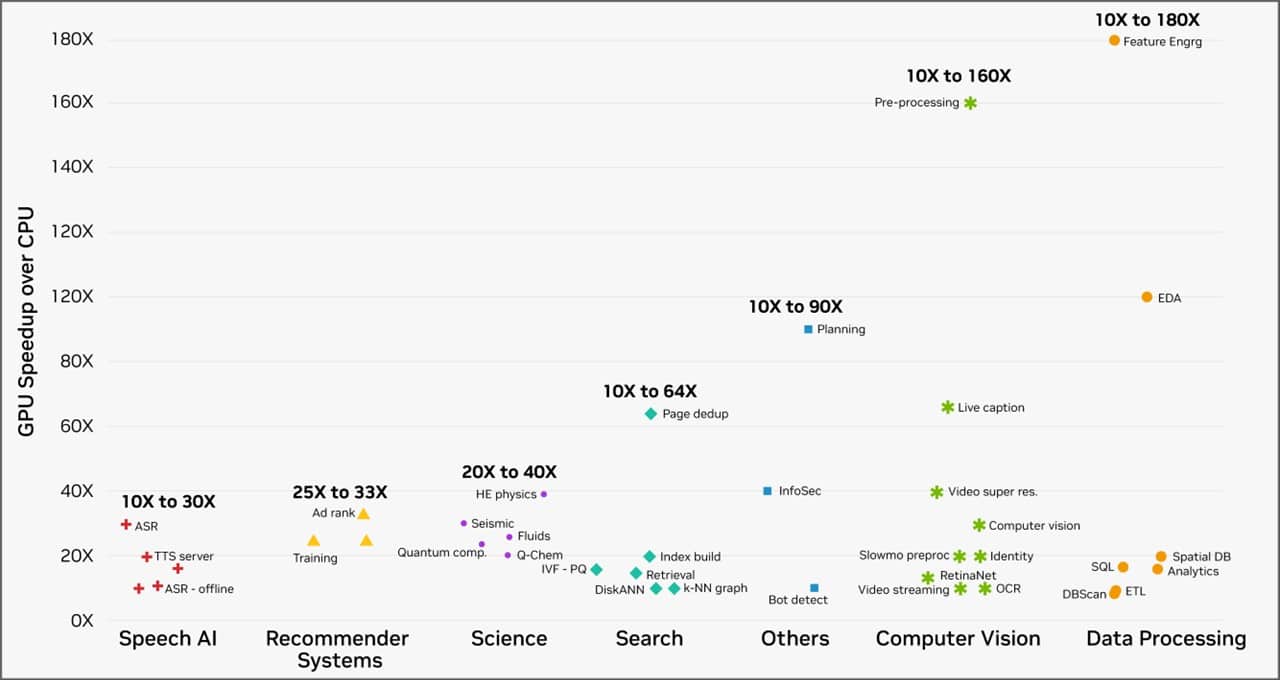
Other reported figures include up to 22-times faster quantum-mechanical calculations with Daviator in NVIDIA ALCHEMI, and a 900-times speedup for cell-polygon calculations with the open-source cuSpa library compared with CPUs. NVIDIA also reported that Therna Biosciences processed data 200 times faster using rapids-singlecell, while Basecamp Research’s HMMER searches ran up to 84 times faster than standard HMMER.

These figures come from NVIDIA’s descriptions of specific tools and workflows, rather than one standardized comparison across all scientific workloads. The examples show how faster data processing could help research teams examine larger datasets or respond during experiments, but the reported gains depend on the application and comparison described.

Industry Impact

Faster scientific computing workflows

Astronomy, fusion research, drug discovery, materials science and biology

Overview

NVIDIA’s expanded CUDA-X tools could help research teams process larger datasets and inspect results sooner, including during ongoing simulations. Reported examples range from astronomy analysis reduced from more than a month to eight minutes to faster molecular and biological data processing. For researchers and scientific software developers, the practical impact will depend on workload fit and integration effort. The figures are NVIDIA-reported results from different tools and comparisons, not a standardized benchmark, so organizations should validate performance against their own workflows before committing.

Key Impact Points

GPU libraries can shorten processing cycles across several distinct scientific workloads.

Interactive analysis during simulations may help teams examine emerging results sooner.

Reported speedups vary by application and comparison, making workload-specific testing essential.

Opportunities

Scientific workflow acceleration

Research computing, drug discovery and biological data analysis

The examples create a practical opening for scientific software teams and research organizations to integrate GPU libraries into existing analysis pipelines. Potential work includes adapting established applications, validating accuracy and stability, and enabling researchers to inspect simulation or experiment data sooner. Drug-discovery organizations named in the article are adopting cuPotential, while other examples cover astronomy, fusion and biological data. These are workflow opportunities rather than evidence of a disclosed pricing model or new standalone service. Any business case should account for integration and compute costs and benchmark the relevant workload; NVIDIA’s reported gains are application-specific.

  • GPU-accelerated scientific analysis integration

    Problem: Scientific teams may spend substantial time processing large datasets or waiting for simulation results.

    Solution: Integrate relevant CUDA-X libraries into existing research software and validate performance on target workloads.

    Target Users: Research teams and scientific software developers in astronomy, fusion, drug discovery and biology.

    Business Value: Potentially faster analysis and earlier access to computational results, subject to workload-specific testing.

    Revenue Potential: The article does not disclose pricing or revenue. Integration and support may offer service opportunities, but commercial demand is not quantified.

Reference link

https://blogs.nvidia.com/blog/cuda-x-libraries-agents-accelerate-scientific-discovery

Image Source Link

https://blogs.nvidia.com/wp-content/uploads/2024/08/hpc-accelerated-computing-speedups.jpg

Community Discussion (0)

Loading discussions...