
NVIDIA, Samsung, Kakao Mobility and LG Apply AI to Chips, Vehicles and Robots
AI Industry Applications

NVIDIA, Samsung, Kakao Mobility and LG Apply AI to Chips, Vehicles and Robots

NVIDIANov 9, 2026

NVIDIA outlined Korean collaborations spanning faster semiconductor simulations, Level 4 autonomous-driving development and robotic manufacturing demonstrations.

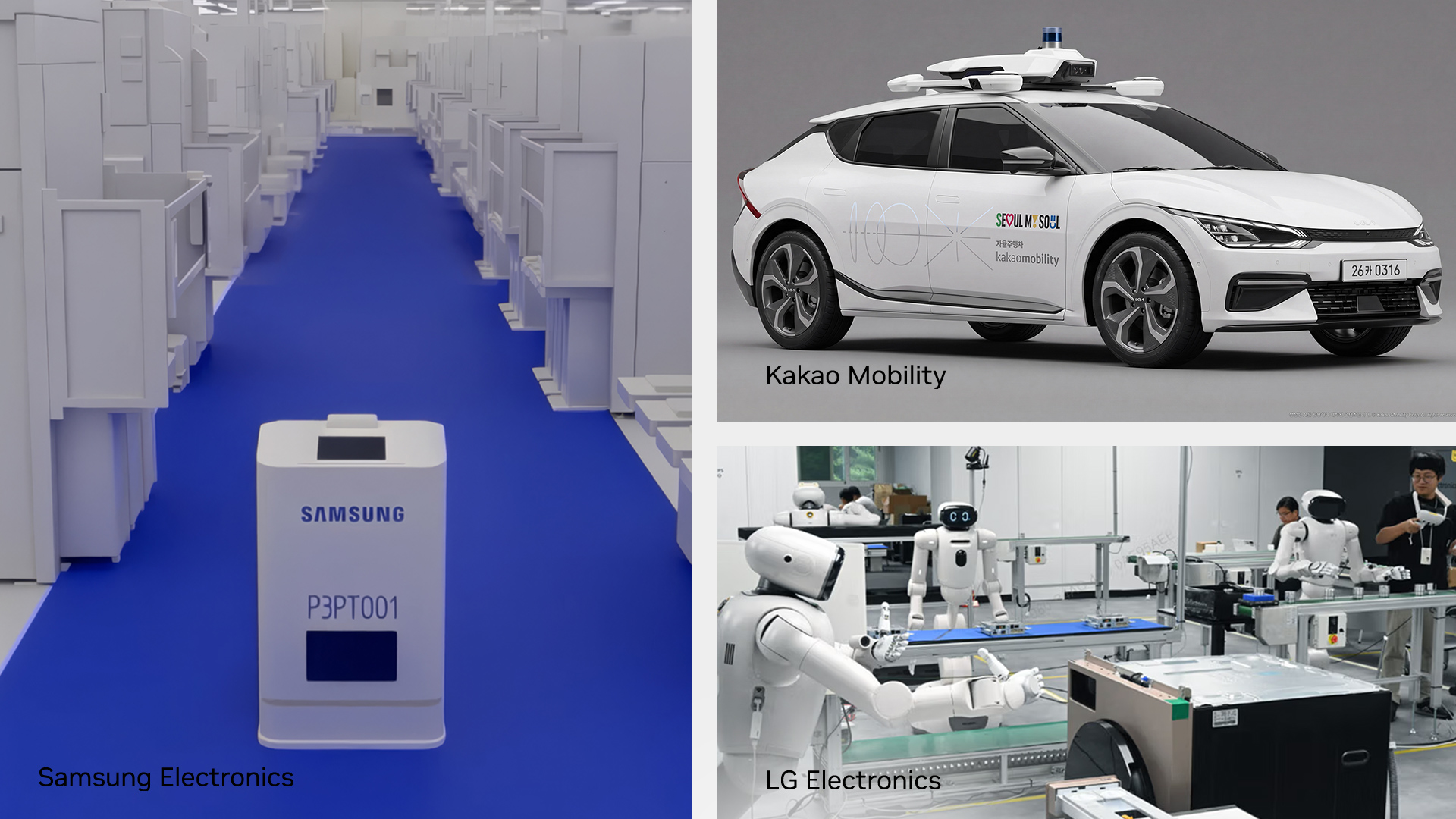
NVIDIA described a set of collaborations with South Korean companies applying AI and accelerated computing to semiconductor engineering, autonomous driving and factory robotics. The company published the update on November 8, 2026, highlighting work with Samsung Electronics, Kakao Mobility and LG Electronics.

Samsung is using NVIDIA computing tools across materials research, semiconductor process development and device engineering. For selected quantum-chemistry calculations on Samsung’s sMOL platform, NVIDIA says the work ran up to five times faster end to end with cuEST. In a separate thermal and mechanical analysis example, an AI-assisted workflow using coarser grids and GPU acceleration took 41 seconds, compared with about 18 hours for a fine-grid solve on a 32-core CPU. NVIDIA reported that comparison as roughly a 1,600-fold speedup; it describes a specific workflow, not a general result for all chip simulations.

Kakao Mobility plans to develop a Level 4 autonomous-driving system using its driving software and operating experience in Seoul’s Gangnam district alongside NVIDIA vehicle technologies. The planned work includes NVIDIA Hyperion, powered by DRIVE AGX Thor, and NVIDIA Halos for safety development and validation. Initial development is planned around Kia purpose-built vehicles, with the aim of supporting future Level 4 mobility services in Korea.

NVIDIA and LG Electronics also demonstrated robotic manipulation and manufacturing tasks using LG’s CLOiD robot in a manufacturing environment. Their workflow links real-world data collection with Cosmos-based data augmentation, training of NVIDIA Isaac GR00T models, Jetson AGX Thor onboard computing and simulation-based evaluation. The teams are using the process to refine how they train, evaluate and improve the robot’s manufacturing capabilities.

Together, the examples show distinct development efforts rather than a single deployed system: semiconductor engineering workflows, planned autonomous-driving development and a demonstrated robot-training process.

Industry Impact

AI Moves Into Engineering and Physical Systems

Semiconductors, autonomous mobility and manufacturing

Overview

The collaborations show AI and accelerated computing being applied to distinct industrial workflows, from semiconductor simulations to autonomous-driving development and robot training. Samsung’s reported speedups are specific to selected workflows, not a general benchmark for chip simulation. Kakao Mobility’s Level 4 work remains planned development, while LG and NVIDIA demonstrated a robot-training process rather than a deployed manufacturing system. For engineering and business leaders, the near-term signal is growing experimentation with GPU- and simulation-based methods; longer-term value will depend on validation, integration and deployment.

Key Impact Points

Samsung’s examples indicate that GPU-accelerated, AI-assisted workflows can reduce time for selected semiconductor engineering calculations.

Kakao Mobility plans Level 4 development using NVIDIA vehicle and safety technologies, but the article does not report a deployed service.

LG and NVIDIA demonstrated a process for collecting data, training robot models and evaluating manufacturing tasks in simulation.

Opportunities

Industrial AI Workflow Opportunities

Chip engineering, mobility and factory robotics

The article supports potential enterprise opportunities in accelerating selected engineering simulations and improving robot-training workflows. Semiconductor teams could assess GPU- and AI-assisted methods against their own workloads, while manufacturers could explore linked data collection, simulation and model evaluation for robotic tasks. These are areas for evaluation, not established offerings or guaranteed results. The autonomous-driving collaboration also points to development demand for vehicle software and safety validation, although the article gives no evidence of a launched service or external product availability. Any business case should be built around measured performance, integration effort and validation requirements.

  • Accelerated Semiconductor Engineering Workflows

    Problem: Selected materials, process and device-engineering calculations can require substantial computing time.

    Solution: Evaluate GPU-accelerated and AI-assisted workflows for specific semiconductor simulation tasks, benchmarking them against existing methods.

    Target Users: Semiconductor engineering and research teams.

    Business Value: Potentially shorten selected calculation cycles and support faster engineering iteration; results will depend on workload and validation.

    Revenue Potential: Possible value through internal productivity gains or engineering workflow services, but the article does not establish a commercial offering or revenue.

Reference link

https://blogs.nvidia.com/blog/korea-physical-ai-ecosystem

Image Source Link

https://blogs.nvidia.com/wp-content/uploads/2026/11/omniverse-overall-ai-day-seoul-1920x1080-1.jpeg

Community Discussion (0)

Loading discussions...