
NVIDIA says its open 5G and 6G software has surpassed one million downloads, with researchers reporting gains in robotics, reception and network energy use.
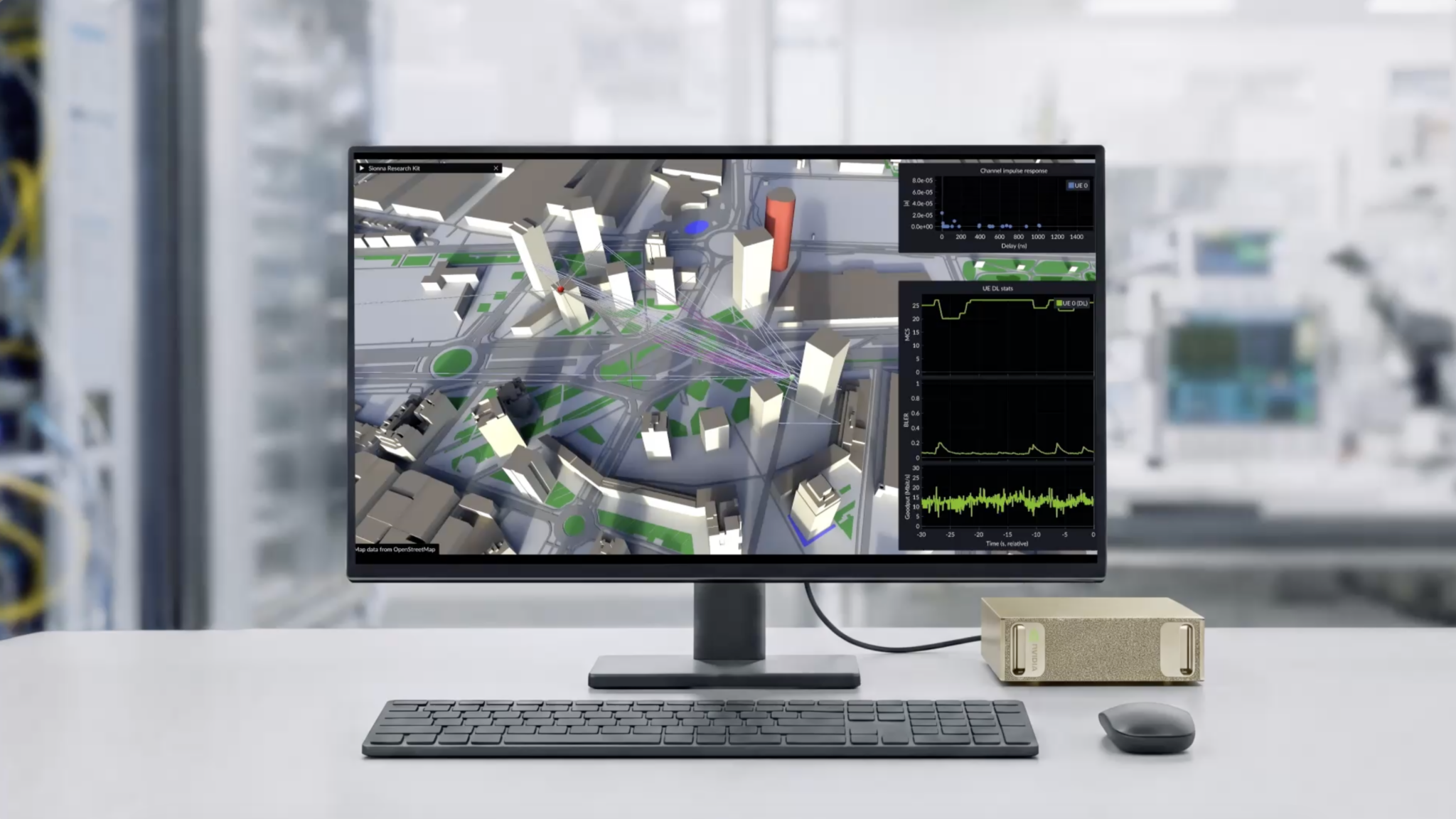
NVIDIA said on November 6, 2026, that downloads of its open-source 5G and 6G tools have passed one million and that more than 8,000 research and academic institutions use the software. The company also reported a tenfold increase over the past year in developer adoption of NVIDIA AI Aerial and Sionna. The tools support work spanning wireless simulation, AI training and tests on real radio systems.
The company highlighted projects from several research groups. At King’s College London, a camera-equipped robot arm used Sionna in experiments involving fruit packing and cube stacking. Researchers reported that sending compact descriptions of objects instead of periodic images reduced task completion time by up to 52.6% in tests with deliberately introduced faults. The system also recovered from unsuccessful actions and, in some configurations, checked planned movements against a digital twin.
Other demonstrations focused on radio performance and power. SoftBank tested a neural receiver integrated with NVIDIA Aerial CUDA-Accelerated RAN using a commercial 5G smartphone. In controlled interference tests, it achieved higher uplink throughput than a conventional receiver at all 15 tested settings, with a maximum gain of roughly 60%. At the University of Leeds, a system forecast network demand 10 minutes ahead to guide base-station sleep decisions; researchers reported a 45.6% reduction in radio access network power consumption against a full-power baseline while maintaining device connectivity.
For simulation, the Centre Tecnològic de Telecomunicacions de Catalunya integrated GPU-accelerated radio-channel models with the open-source 5G-LENA network simulator. In an early evaluation, runtime fell from about three hours to 10–20 minutes, depending on the integration, while preserving expected statistical behavior and network performance.
These results come from separate research demonstrations, not a single standardized comparison. Together, they illustrate how the open tools are being applied to robot connectivity, signal processing, energy management and faster network experimentation as researchers develop 6G systems.