
Opera Begins Previewing Local AI Access for Websites and Browser Extensions
NO IMAGE
AI Agents & Automation

Opera Begins Previewing Local AI Access for Websites and Browser Extensions

Opera NewsroomOct 27, 2026

Opera has started rolling out an opt-in preview that lets websites and extensions use AI models running directly on users’ computers.

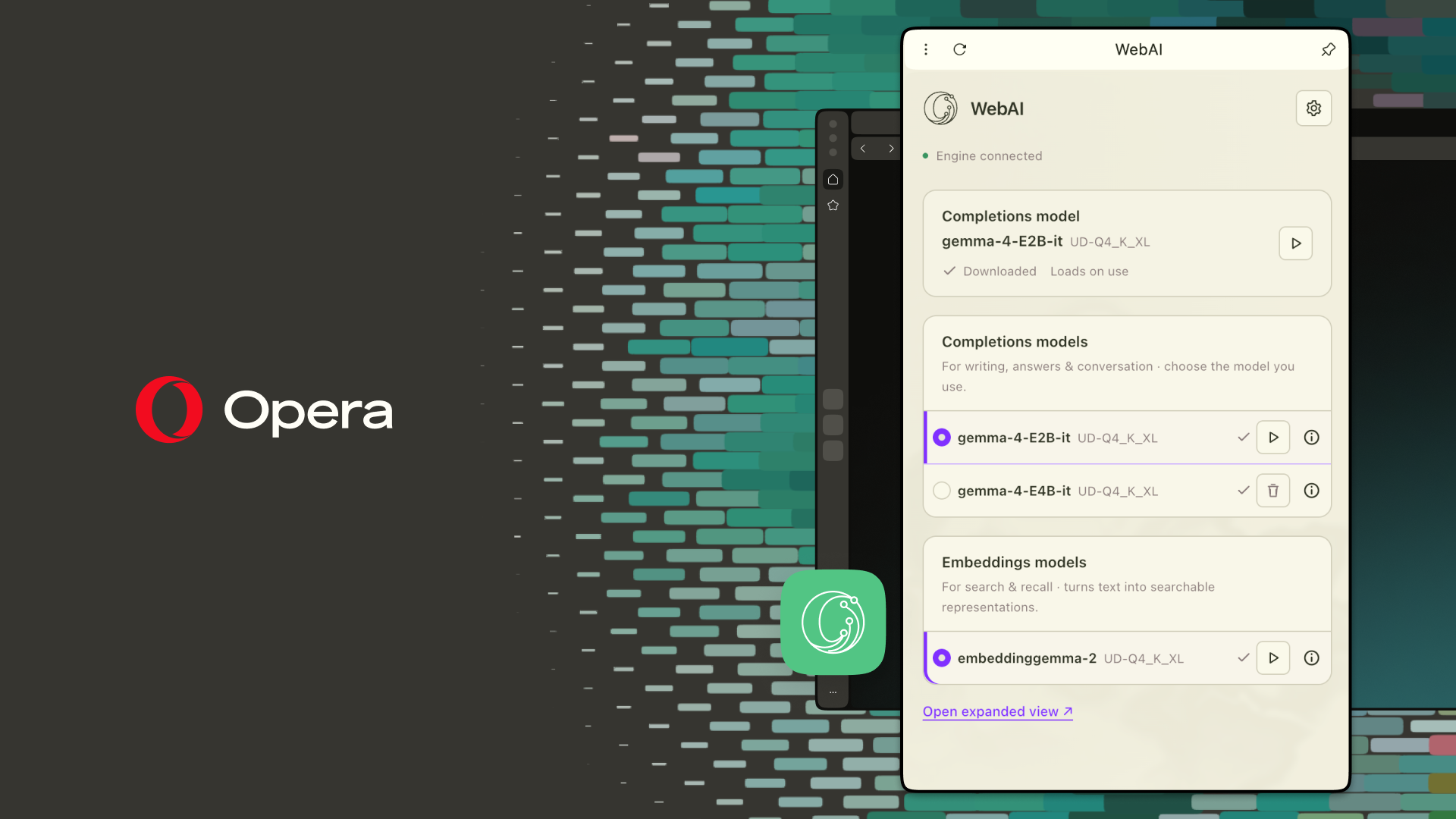
Opera began rolling out local AI models in its browsers on October 27, introducing an early preview of WebAI in Opera One. The feature lets websites and browser extensions use AI hosted by the browser, rather than sending requests to a remote AI service. Opera says Opera GX and Opera Neon are expected to follow.

WebAI is a proposed web standard, not an Opera-only model. Opera’s implementation is model-agnostic and supports open models; at launch, users can access Google’s Gemma and, on Macs, Apple’s on-device foundation model. The browser can use these models to generate text, classify content and identify relationships between information. Opera says developers can build such features without operating AI infrastructure or paying for each request.

The preview is opt-in: models are not downloaded until users enable the feature, and site-specific permissions let them decide which websites can access local AI. Availability is initially limited to 64-bit Windows computers with Intel or AMD processors and Macs with Apple silicon. Processing takes place on the user’s device, so performance depends on its hardware.

The launch brings local-model access from an experimental developer build Opera introduced in 2024 into its consumer browser. It also gives extension developers a way to experiment with AI features that can work without sending the handled information to an AI service. Opera’s examples include extensions that sort tabs or flag clickbait, though these are demonstrations rather than announced built-in browser functions. The company says it plans to add more models optimized for different devices and additional development tools. The broader significance will depend on which models Opera supports, how well they run across different computers, and whether developers build useful extensions around the permission-based approach.

Industry Impact

AI moves into the browser

Browser software; web development; browser extensions

Overview

Opera’s opt-in preview gives website and extension developers a way to test AI features that run on users’ devices instead of relying on remote AI services. In the short term, developers must account for limited device availability, hardware-dependent performance and site-level permissions. Product managers can evaluate whether local processing suits features such as content classification or tab organization. Longer term, broader model support and useful extensions will determine whether this browser-based approach gains adoption.

Key Impact Points

Developers can experiment with AI features without running model infrastructure or paying for each remote request.

On-device processing offers a way to handle information without sending it to an AI service.

Initial support is limited to specified Windows PCs and Apple-silicon Macs, and performance varies by hardware.

Opportunities

Build local-AI browser features

Browser extensions; web development

WebAI creates a practical testing ground for developers seeking to add AI features to websites or browser extensions without operating remote model infrastructure or paying per request. Potential applications include the article’s examples of sorting tabs and flagging clickbait, as well as text generation, content classification and identifying relationships between information. The opportunity is currently experimental: access is opt-in, compatibility is limited to supported computers, and processing speed depends on device hardware. Developers can test user demand and permission flows now, while treating any extension revenue or broader adoption as uncertain; the article does not identify a business model.

  • Local-AI browser extensions

    Problem: Browser extension developers may face infrastructure requirements and per-request costs when adding AI features through remote services.

    Solution: Use Opera’s WebAI preview to experiment with features powered by models running on users’ computers.

    Target Users: Browser extension developers and website developers.

    Business Value: Test AI features such as tab sorting or content classification without operating remote AI infrastructure or paying for each request.

    Revenue Potential: No revenue model is specified. Any monetization opportunity remains uncertain and would depend on useful features and user adoption.

Reference link

https://press.opera.com/2026/10/27/opera-doubles-down-on-local-ai-shipping-models-directly-in-its-browsers

Image Source Link

https://www-static-sites.operacdn.com/wp-content/uploads/sites/5/2026/10/Opera-WebAI-Press-01.png

Community Discussion (0)

No discussions yet. Be the first to start the conversation!