
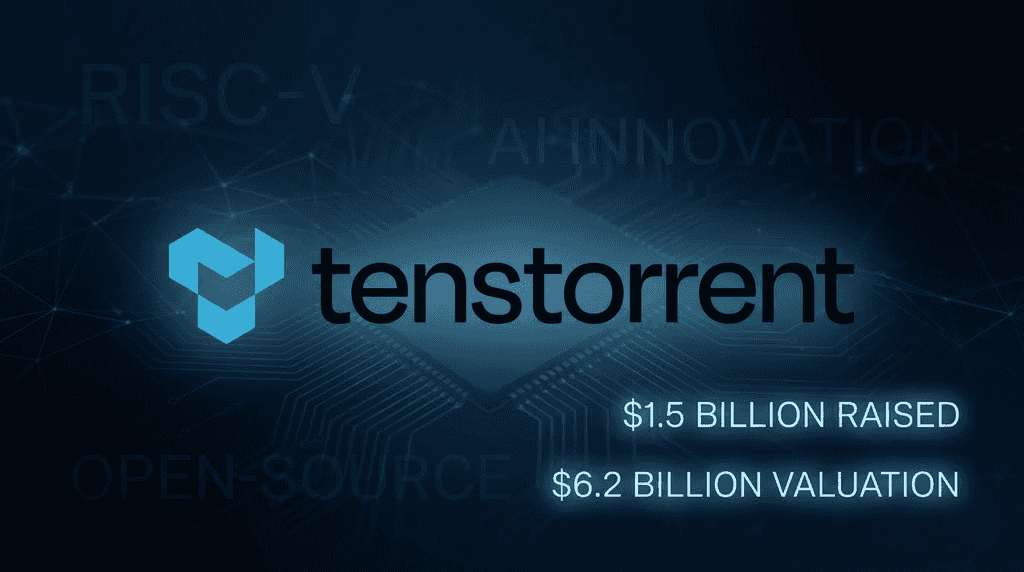
Tenstorrent closed a $1.5 billion Series E at a $6.2 billion valuation, saying it will fund server deployments, manufacturing, and commercial expansion.
AI computing company Tenstorrent says it has closed a $1.5 billion Series E round at a post-money valuation of $6.2 billion. The October 19 announcement identifies Trace Capital and Innovation X as lead investors, alongside a broad group of new and existing backers, including Fidelity Management & Research Company, Samsung-related investor interests through the company’s existing ecosystem, Sandisk, Tether Investments, and financial firms. The company’s release describes the financing as supporting volume manufacturing and global commercial expansion.
Tenstorrent plans to use the proceeds to deploy its Galaxy servers at scale, serve open-weight language and video-generation models, and advance AI and CPU intellectual property that it licenses to customers designing their own silicon. Its business spans accelerator cards, workstations, server systems, and licensed processor designs. The company also emphasizes an open-source software stack intended to let developers run models locally and enterprises deploy systems on premises. CEO Jim Keller has positioned the strategy around offering a common architecture across different computing scales.
The financing is a notable bet on alternatives to the dominant AI accelerator supply chain, especially for organizations seeking inference capacity, local deployment, or more control over chip design. However, a large funding round and stated plans do not by themselves establish that Tenstorrent’s products can match competitors on performance, availability, software maturity, or total cost at production scale. The company’s stated priorities—manufacturing, server rollouts, and commercial expansion—will be important tests of execution. If it can deliver, the funding could help broaden the market for non-incumbent AI compute and open-weight model deployments. For infrastructure buyers and chip designers, the announcement signals investor interest in vertically integrated challengers combining hardware, software, systems, and licensable IP.