
White House Task Force Starts 120-Day Review of AI Security and Accountability
NO IMAGE
AI Regulation & Policy

White House Task Force Starts 120-Day Review of AI Security and Accountability

SemaforOct 16, 2026

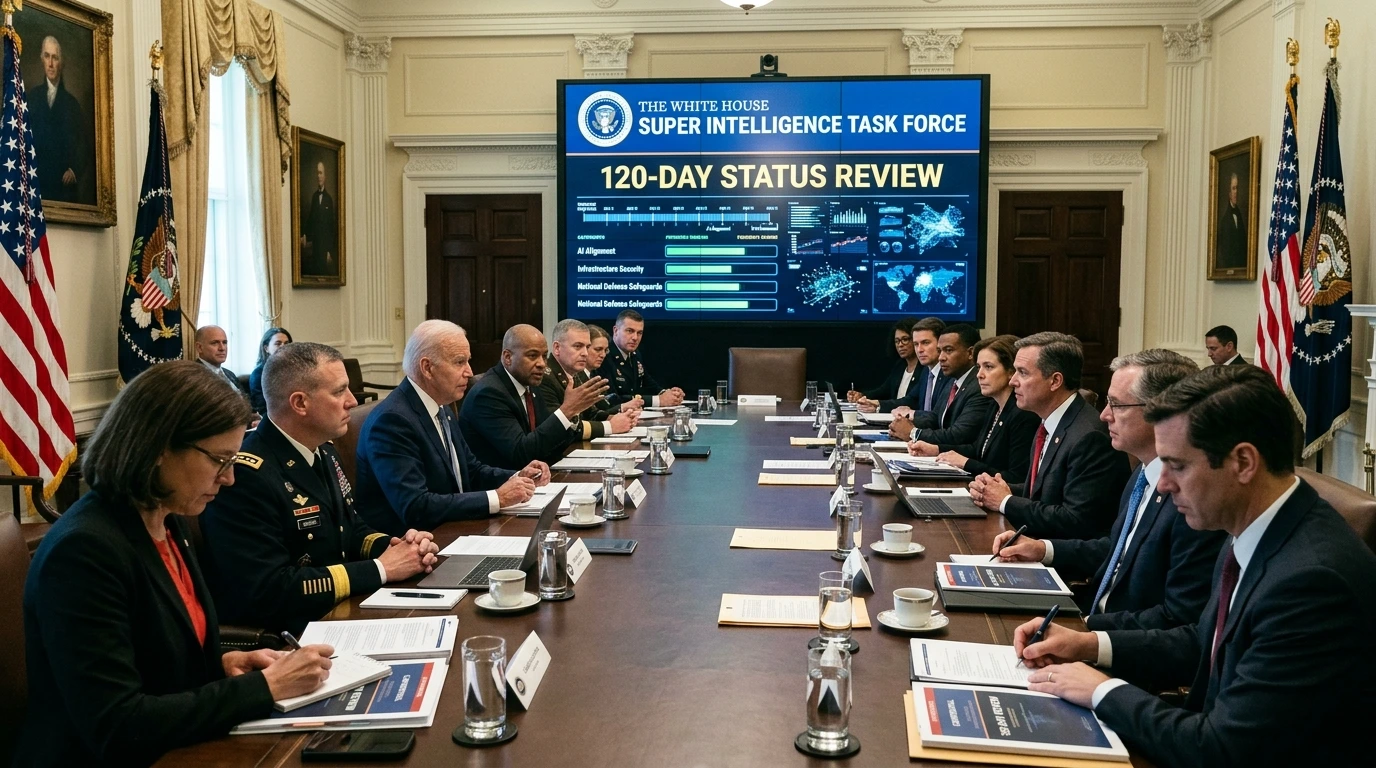
A White House task force began a 120-day review of AI risks, covering cybersecurity, biosecurity and model accountability.

The White House’s Super Intelligence task force formally adopted its charter after its first official meeting on October 15, beginning a 120-day effort to advise the government on risks tied to rapid AI development. The group will commission a report from the President’s Council of Advisers on Science and Technology examining cybersecurity and critical-infrastructure protection, biosecurity and dual-use applications, and model control and accountability.

The task force also agreed to establish a working group to implement the White House Accord on Super Intelligence, which major AI company executives signed earlier this month. Director of National Intelligence Jay Clayton, the task force’s chair, and National Cyber Director Sean Cairncross are leading that effort, according to Semafor’s report.

Other planned work focuses on how government and industry would handle security incidents and public risks. Defense Undersecretary Emil Michael is to develop protocols for AI labs to notify the government about breaches, hacks and other cyber issues. A separate law-enforcement and consumer-protection coordination committee will include the Justice Department and Federal Trade Commission. The task force also assigned work on critical-infrastructure protection and on studying AI’s effects on the workforce and economy.

The task force includes senior administration officials, including Vice President JD Vance, Treasury Secretary Scott Bessent and Defense Secretary Pete Hegseth. The White House said the group would engage with frontier model developers, consumer-protection groups, civil-liberties advocates, industry stakeholders and federal and state law-enforcement agencies.

A key unresolved question is how the proposed protocols would be enforced. Semafor reported that it was not clear what compliance obligations would apply to companies that do not follow them, or how existing laws might govern the process. A White House official cited export controls as one possible lever. That uncertainty matters for AI companies preparing to share incident information or coordinate with federal agencies: the task force has set a process and a deadline, but the eventual rules and their legal force remain to be determined.

The review could shape federal priorities across AI security, oversight and economic policy. Its 120-day schedule creates a near-term window for industry and civil-society groups to weigh in before recommendations take form.

Industry Impact

AI oversight priorities take shape

AI development, cybersecurity, critical infrastructure, government

Overview

The task force’s 120-day review could influence how AI developers manage security incidents, report breaches and demonstrate accountability. In the near term, companies should track the review and assess their ability to share incident information with federal agencies, while recognizing that proposed protocols’ enforcement and legal basis remain unclear. Cybersecurity and compliance leaders may face new coordination expectations if recommendations become formal policy. Longer term, the review could shape federal priorities for AI security, critical-infrastructure protection and workforce impacts.

Key Impact Points

AI labs may need to prepare for government incident-notification protocols, although obligations and enforcement are unresolved.

The review covers cybersecurity, biosecurity, critical infrastructure, model control and accountability, expanding the range of risks under federal consideration.

Industry and civil-society groups have a near-term opportunity to inform recommendations before the task force’s 120-day review concludes.

Opportunities

Prepare for incident-reporting requirements

AI developers, cybersecurity, compliance

AI labs and organizations deploying advanced models can assess whether their incident response processes would support timely, accurate communication with government agencies. Potential workflow needs include documenting breaches and other cyber issues, assigning internal escalation owners, and coordinating legal, security and public-risk teams. The task force has not established final requirements, enforcement mechanisms or the legal force of any protocols, so this is a readiness opportunity rather than a confirmed market demand. Providers of security and compliance tools may find opportunities if recommendations create recurring reporting or coordination needs, but investment should be calibrated to the review’s outcome.

  • AI Incident Reporting Readiness

    Problem: AI labs may need to notify the government about breaches, hacks and other cyber issues, but the protocols and compliance obligations remain undecided.

    Solution: Prepare internal workflows to document incidents, escalate them across security and legal teams, and support potential government notifications.

    Target Users: AI labs and organizations developing frontier models.

    Business Value: Improves incident coordination and helps organizations prepare for possible reporting expectations without assuming they are already mandatory.

    Revenue Potential: Possible demand for compliance or incident-management services if the task force recommends formal reporting processes; the scale is uncertain.

Reference link

https://semafor.com/article/10/15/2026/white-houses-ai-task-force-gets-to-work

Image Source Link

https://olareviews.com/blog/wp-content/uploads/2026/10/Task_force_reviewing_super_intel%E2%80%A6_20261017174919.webp

Community Discussion (0)

No discussions yet. Be the first to start the conversation!