NVIDIA says its Vera Rubin platform topped all MLPerf Training v6.1 benchmarks and delivered provisional agentic-inference efficiency gains over GB300.
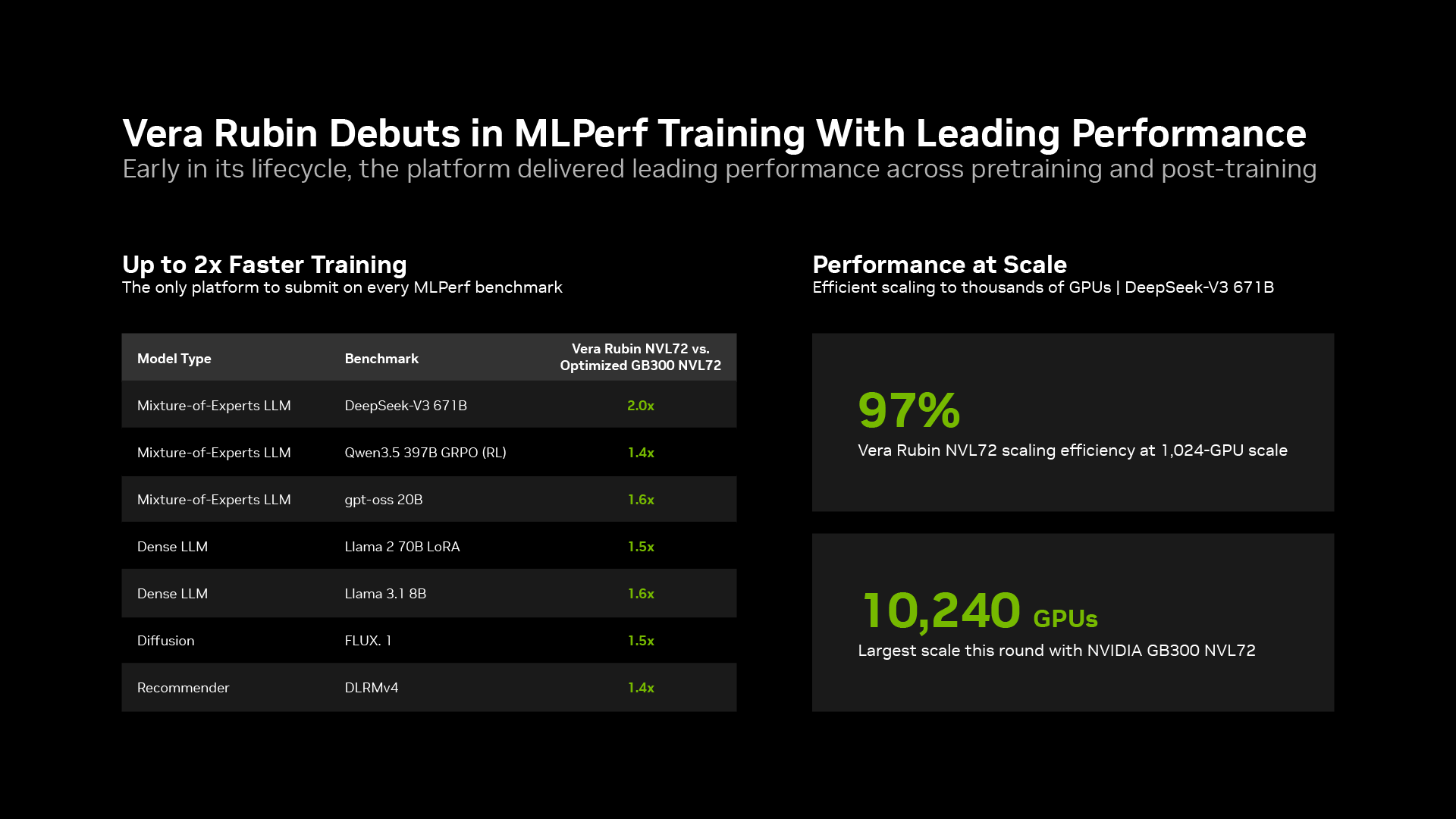
NVIDIA reported results for Vera Rubin in its MLPerf debut on November 16, 2026, saying the platform led every benchmark in the MLPerf Training v6.1 round. The tests covered large language models, image generation, recommender systems and reinforcement-learning post-training. NVIDIA also submitted Vera Rubin to MLPerf Endpoints for the first time, a benchmark that evaluates agent workflows while checking whether tasks are completed correctly.
For training, NVIDIA reported that Vera Rubin NVL72 delivered up to twice the performance per GPU of its GB300 NVL72 system. In a DeepSeek-V3 scaling test, NVIDIA said it expanded from 256 to 1,024 GPUs at about 97% efficiency: the reported training time fell from 16 minutes to roughly four. The largest run in the round used 10,240 GPUs on NVIDIA GB300 systems; Microsoft submitted a run at the same GPU count using GB200 systems.
NVIDIA also highlighted an MLPerf Endpoints result for Kimi K3, a model designed for agentic workflows. At the same minimum average interactivity of 50 tokens per second per user, the company reported more than 10 times the throughput per watt from Vera Rubin NVL72 compared with GB300 NVL72. That figure is provisional: NVIDIA’s post says it was awaiting MLCommons Association verification and could change after peer review.
The results offer a comparison across both model training and inference workloads, where power use and response speed matter alongside raw throughput. NVIDIA attributed the training and scaling performance to its hardware and software systems, including GPU interconnects and data-center networking. The company also said Vera Rubin’s performance could improve through continued software optimization, but did not provide a timeline for those changes in the post.